CALL FOR EXPRESSION OF INTEREST
Overview
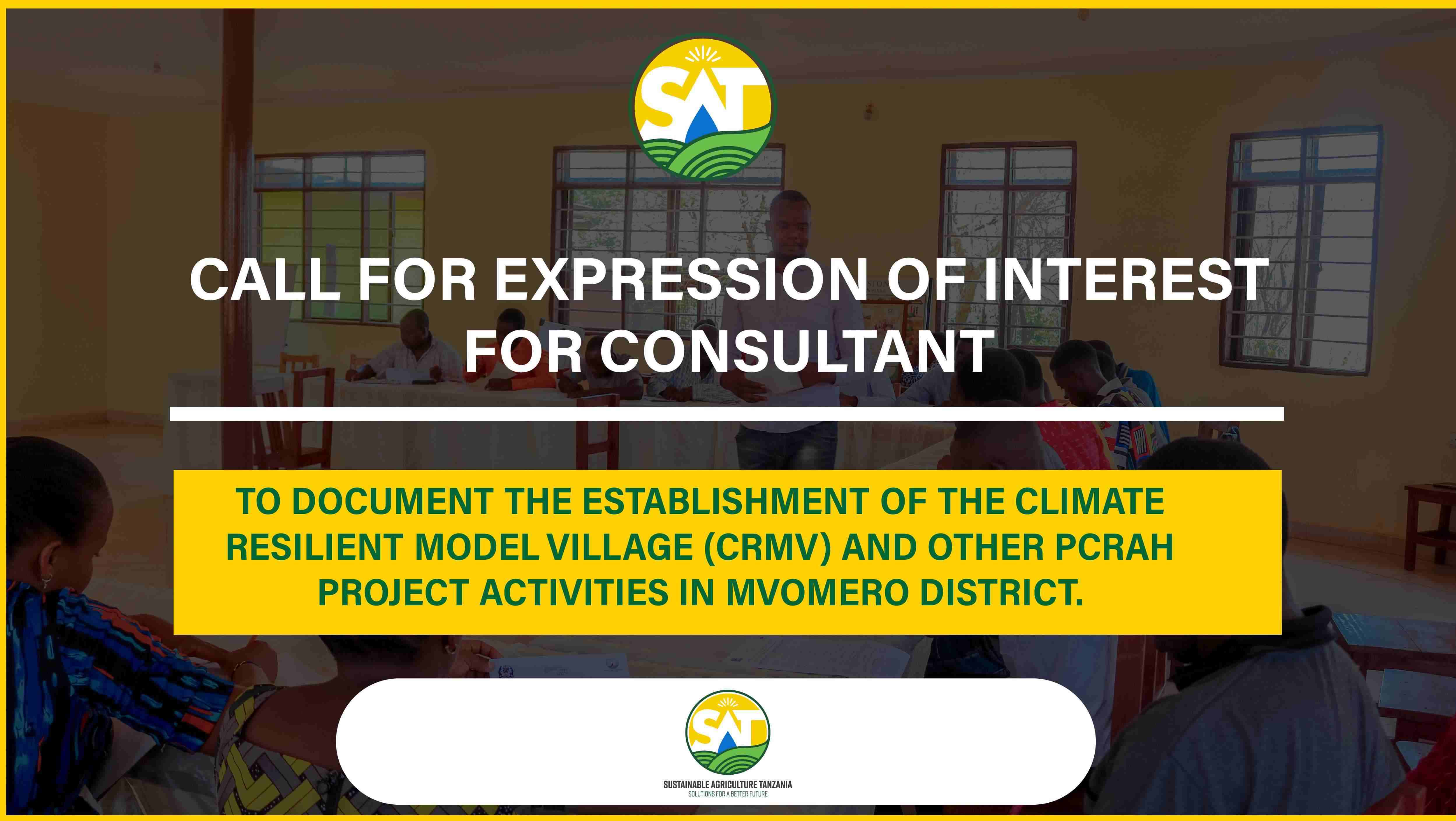
Sustainable Agriculture Tanzania (SAT) is seeking to engage a qualified service provider (individual consultant or firm) to document the establishment and progress of the Climate Resilient Model Village (CRMV) in Msufini, Mvomero District, and the broader activities implemented under the Participatory Climate Risk Assessment Hub in Tanzania (PCRAH) project in other target communities. This documentation will capture the project's achievements, lessons learned, and impact, creating a comprehensive body of evidence and knowledge products for scaling and institutional learning. These Terms of Reference (ToR) serve as a request for proposals from interested consultants/firms.
About PCRAH Project
The Participatory Climate Risk Assessment Hub in Tanzania (PCRAH) project is implemented by SAT with the support of the Protestant Agency for Diakonie and Development for Bread for the World (BftW). The project aims to strengthen climate resilience among vulnerable rural communities and civil society organizations through the implementation of the Participatory Assessment of Climate and Disaster Risks (PACDR) approach. The project promotes participatory, gender-responsive, and community-led climate adaptation planning, disaster risk reduction, and resilience building. A key initiative under the current phase is the establishment of a Climate Resilient Model Village (CRMV) in Msufini, which serves as a practical demonstration site for climate-resilient agriculture, agroforestry, ecosystem restoration, water management, and livelihood diversification. The project also works in other communities including Mkindo, Hembeti, and Dihombo
Objective of the assignment
The main objective of this assignment is to document the establishment and operationalization of the Msufini Climate Resilient Model Village (CRMV) and other key activities of the PCRAH project in Mkindo, Hembeti, and Dihombo. The documentation will serve as a comprehensive case study, generating evidence and knowledge products to inform scaling, replication, and policy engagement.
Specifically, the documentation seeks to:
· Capture the process, successes, challenges, and lessons learned from the establishment and operationalization of the CRMV in Msufini.
· Document the specific Agroecological and Soil and Water Conservation (SWC) practices being applied in the CRMV, including Tied-ridges, Half-moons, Nine-seed hole, Fanya Juu, Fanya Chini contours, and drainage channels.
· Document the implementation of adaptation actions and the progress of community-led resilience initiatives in the other three target communities of Mkindo, Hembeti, and Dihombo.
· Highlight the impact of the PCRAH project on target communities, including aspects of gender equality, social inclusion, and institutional strengthening.
· Develop a set of professional knowledge products (e.g., case studies, a documentary video, photo stories) for dissemination to a wide range of stakeholders
Application and Documentation
Interested qualified service providers are invited to submit their applications. The application should include: An application letter (Expression of Interest), Curriculum Vitae (CV) for an individual or a company profile with CVs of key team members, A conceptual inception report showing how you intend to achieve the stated objectives, including a detailed methodology, A portfolio of previous experience with links to sample work (case studies, videos, photo essays, references), A proposed work plan and detailed budget for undertaking the assignment. Please send your application electronically via consultancy@kilimo.org by 6th November 2026 with the subject line: Consultancy Service for CRMV and PCRAH Documentation. NB: The deadline for submission of EOI will be on 4th November 2026 at 1700hrs East African Time. Late EOIs and portions of EOI shall not be accepted. Only awarded consultant(s) will be contacted.
We are open to receiving questions for clarifications if any through consultancy@kilimo.org until 3rd November 2026 after which no further questions will be received. No in-person or phone follow-up is accepted.


Related Posts